medical specialty
English Thesaurus
1. the branches of medical science that deal with nonsurgical techniques (noun.cognition)
| hypernym | : | medical science, |
| definition | : | the science of dealing with the maintenance of health and the prevention and treatment of disease (noun.cognition) |
| hyponym | : | allergology, |
| definition | : | the branch of medical science that studies the causes and treatment of allergies (noun.cognition) |
| hyponym | : | anesthesiology, |
| definition | : | the branch of medical science that studies and applies anesthetics (noun.cognition) |
| hyponym | : | angiology, |
| definition | : | the branch of medical science that studies the blood and lymph vessels and their disorders (noun.cognition) |
| hyponym | : | bacteriology, |
| definition | : | the branch of medical science that studies bacteria in relation to disease (noun.cognition) |
| hyponym | : | biomedicine, |
| definition | : | the branch of medical science that studies the ability of organisms to withstand environmental stress (as in space travel) (noun.cognition) |
| hyponym | : | biomedicine, |
| definition | : | the branch of medical science that applies biological and physiological principles to clinical practice (noun.cognition) |
| hyponym | : | cardiology, |
| definition | : | the branch of medicine dealing with the heart and its diseases (noun.cognition) |
| hyponym | : | prosthetics, |
| definition | : | the branch of medicine dealing with the production and use of artificial body parts (noun.cognition) |
| hyponym | : | dermatology, |
| definition | : | the branch of medicine dealing with the skin and its diseases (noun.cognition) |
| hyponym | : | emergency medicine, |
| definition | : | the branch of medicine concerned with the prompt diagnosis and treatment of injuries or trauma or sudden illness (noun.cognition) |
| hyponym | : | endocrinology, |
| definition | : | the branch of medicine dealing with the endocrine glands and their secretions (noun.cognition) |
| hyponym | : | epidemiology, |
| definition | : | the branch of medical science dealing with the transmission and control of disease (noun.cognition) |
| hyponym | : | gastroenterology, |
| definition | : | the branch of medicine that studies the gastrointestinal tract and its diseases (noun.cognition) |
| hyponym | : | geriatrics, gerontology, |
| definition | : | the branch of medical science that deals with diseases and problems specific to old people (noun.cognition) |
| hyponym | : | gynaecology, gynecology, |
| definition | : | the branch of medicine that deals with the diseases and hygiene of women (noun.cognition) |
| hyponym | : | haematology, hematology, |
| definition | : | the branch of medicine that deals with diseases of the blood and blood-forming organs (noun.cognition) |
| hyponym | : | hygiene, hygienics, |
| definition | : | the science concerned with the prevention of illness and maintenance of health (noun.cognition) |
| hyponym | : | immunology, |
| definition | : | the branch of medical science that studies the body's immune system (noun.cognition) |
| hyponym | : | general medicine, internal medicine, |
| definition | : | the branch of medicine that deals with the diagnosis and (nonsurgical) treatment of diseases of the internal organs (especially in adults) (noun.cognition) |
| hyponym | : | nephrology, |
| definition | : | the branch of medicine concerned with the kidney - its development and anatomy and physiology and disorders (noun.cognition) |
| hyponym | : | nuclear medicine, |
| definition | : | the branch of medicine that uses radioactive materials either to image a patient's body or to destroy diseased cells (noun.cognition) |
| hyponym | : | clinical neurology, neurology, |
| definition | : | (neurology) the branch of medicine that deals with the nervous system and its disorders (noun.cognition) |
| hyponym | : | neuropsychiatry, |
| definition | : | the branch of medicine dealing with mental disorders attributable to diseases of the nervous system (noun.cognition) |
| hyponym | : | diagnostics, nosology, |
| definition | : | the branch of medical science dealing with the classification of disease (noun.cognition) |
| hyponym | : | oncology, |
| definition | : | the branch of medicine concerned with the study and treatment of tumors (noun.cognition) |
| hyponym | : | ophthalmology, |
| definition | : | the branch of medicine concerned with the eye and its diseases (noun.cognition) |
| hyponym | : | otology, |
| definition | : | the branch of medicine concerned with the ear (noun.cognition) |
| hyponym | : | pharmaceutics, pharmacy, |
| definition | : | the art and science of preparing and dispensing drugs and medicines, (noun.cognition) |
| hyponym | : | chiropody, podiatry, |
| definition | : | the branch of medicine concerned with the feet (noun.cognition) |
| hyponym | : | proctology, |
| definition | : | the branch of medicine dealing with the diagnosis and treatment of disorders of the colon or rectum or anus (noun.cognition) |
| hyponym | : | rheumatology, |
| definition | : | the branch of medicine dealing with the study and treatment of pathologies of the muscles or tendons or joints (noun.cognition) |
| hyponym | : | space medicine, |
| definition | : | the branch of medicine concerned with the effects of space flight on human beings (noun.cognition) |
| hyponym | : | sports medicine, |
| definition | : | the branch of medicine concerned with the treatment of injuries or illness resulting from athletic activities (noun.cognition) |
| hyponym | : | therapeutics, |
| definition | : | branch of medicine concerned with the treatment of disease (noun.cognition) |
| hyponym | : | thoracic medicine, |
| definition | : | the branch of medicine that deals with the diagnosis and treatment of diseases of the chest (noun.cognition) |
| hyponym | : | accident surgery, traumatology, |
| definition | : | the branch of medicine that deals with the surgical repair of injuries and wounds arising from accidents (noun.cognition) |
| hyponym | : | tropical medicine, |
| definition | : | the branch of medicine that deals with the diagnosis and treatment of diseases that are found most often in tropical regions (noun.cognition) |
| hyponym | : | urogenital medicine, urology, |
| definition | : | the branch of medicine that deals with the diagnosis and treatment of disorders of the urinary tract or urogenital system (noun.cognition) |
| hyponym | : | veterinary medicine, |
| definition | : | the branch of medicine that deals with the diagnosis and treatment of diseases and injuries of animals (especially domestic animals) (noun.cognition) |
| hyponym | : | virology, |
| definition | : | the branch of medical science that studies viruses and viral diseases (noun.cognition) |
| domain member category | : | emergency procedure, |
| definition | : | (medicine) a procedure adopted to meet an emergency (especially a medical emergency) (noun.act) |
| domain member category | : | infusion, |
| definition | : | (medicine) the passive introduction of a substance (a fluid or drug or electrolyte) into a vein or between tissues (as by gravitational force) (noun.act) |
| domain member category | : | medicine, practice of medicine, |
| definition | : | the learned profession that is mastered by graduate training in a medical school and that is devoted to preventing or alleviating or curing diseases and injuries (noun.act) |
| domain member category | : | uranalysis, urinalysis, |
| definition | : | (medicine) the chemical analysis of urine (for medical diagnosis) (noun.act) |
| domain member category | : | scatology, |
| definition | : | (medicine) the chemical analysis of excrement (for medical diagnosis or for paleontological purposes) (noun.act) |
| domain member category | : | therapy, |
| definition | : | (medicine) the act of caring for someone (as by medication or remedial training etc.) (noun.act) |
| domain member category | : | irrigation, |
| definition | : | (medicine) cleaning a wound or body organ by flushing or washing out with water or a medicated solution (noun.act) |
| domain member category | : | bloodletting, |
| definition | : | formerly used as a treatment to reduce excess blood (one of the four humors of medieval medicine) (noun.act) |
| domain member category | : | imaging, tomography, |
| definition | : | (medicine) obtaining pictures of the interior of the body (noun.act) |
| domain member category | : | venipuncture, |
| definition | : | (medicine) puncture of a vein through the skin in order to withdraw blood for analysis or to start an intravenous drip or to inject medication or a radiopaque dye (noun.act) |
| domain member category | : | monster, teras, |
| definition | : | (medicine) a grossly malformed and usually nonviable fetus (noun.animal) |
| domain member category | : | gauze, gauze bandage, |
| definition | : | (medicine) bleached cotton cloth of plain weave used for bandages and dressings (noun.artifact) |
| domain member category | : | balm, ointment, salve, unction, unguent, |
| definition | : | semisolid preparation (usually containing a medicine) applied externally as a remedy or for soothing an irritation (noun.artifact) |
| domain member category | : | percussor, plessor, plexor, |
| definition | : | (medicine) a small hammer with a rubber head used in percussive examinations of the chest and in testing reflexes (noun.artifact) |
| domain member category | : | truss, |
| definition | : | (medicine) a bandage consisting of a pad and belt; worn to hold a hernia in place by pressure (noun.artifact) |
| domain member category | : | achromia, |
| definition | : | an absence of normal pigmentation especially in the skin (as in albinism) or in red blood cells (noun.attribute) |
| domain member category | : | succedaneum, |
| definition | : | (medicine) something that can be used as a substitute (especially any medicine that may be taken in place of another) (noun.cognition) |
| domain member category | : | regime, regimen, |
| definition | : | (medicine) a systematic plan for therapy (often including diet) (noun.cognition) |
| domain member category | : | germ theory, |
| definition | : | (medicine) the theory that all contagious diseases are caused by microorganisms (noun.cognition) |
| domain member category | : | indication, |
| definition | : | (medicine) a reason to prescribe a drug or perform a procedure (noun.communication) |
| domain member category | : | contraindication, |
| definition | : | (medicine) a reason that makes it inadvisable to prescribe a particular drug or employ a particular procedure or treatment (noun.communication) |
| domain member category | : | invasion, |
| definition | : | (pathology) the spread of pathogenic microorganisms or malignant cells to new sites in the body (noun.event) |
| domain member category | : | carrier, immune carrier, |
| definition | : | (medicine) a person (or animal) who has some pathogen to which he is immune but who can pass it on to others (noun.person) |
| domain member category | : | clinician, |
| definition | : | a practitioner (of medicine or psychology) who does clinical work instead of laboratory experiments (noun.person) |
| domain member category | : | donor, |
| definition | : | (medicine) someone who gives blood or tissue or an organ to be used in another person (the host) (noun.person) |
| domain member category | : | host, |
| definition | : | (medicine) recipient of transplanted tissue or organ from a donor (noun.person) |
| domain member category | : | rejection, |
| definition | : | (medicine) an immunological response that refuses to accept substances or organisms that are recognized as foreign (noun.phenomenon) |
| domain member category | : | license fee, license tax, licensing fee, |
| definition | : | a fee paid to the government for the privilege of being licensed to do something (as selling liquor or practicing medicine) (noun.possession) |
| domain member category | : | chelation, |
| definition | : | (medicine) the process of removing a heavy metal from the bloodstream by means of a chelate as in treating lead or mercury poisoning (noun.process) |
| domain member category | : | festering, maturation, suppuration, |
| definition | : | (medicine) the formation of morbific matter in an abscess or a vesicle and the discharge of pus (noun.process) |
| domain member category | : | infection, |
| definition | : | (medicine) the invasion of the body by pathogenic microorganisms and their multiplication which can lead to tissue damage and disease (noun.process) |
| domain member category | : | insufflation, |
| definition | : | (medicine) blowing air or medicated powder into the lungs (or into some other body cavity) (noun.process) |
| domain member category | : | potentiation, |
| definition | : | (medicine) the synergistic effect of two drugs given simultaneously (noun.process) |
| domain member category | : | zymosis, |
| definition | : | (medicine) the development and spread of an infectious disease (especially one caused by a fungus) (noun.process) |
| domain member category | : | reserve, |
| definition | : | (medicine) potential capacity to respond in order to maintain vital functions (noun.quantity) |
| domain member category | : | curvature, |
| definition | : | (medicine) a curving or bending; often abnormal (noun.state) |
| domain member category | : | malignance, malignancy, |
| definition | : | (medicine) a malignant state; progressive and resistant to treatment and tending to cause death (noun.state) |
| domain member category | : | symptom, |
| definition | : | (medicine) any sensation or change in bodily function that is experienced by a patient and is associated with a particular disease (noun.state) |
| domain member category | : | sign, |
| definition | : | (medicine) any objective evidence of the presence of a disorder or disease (noun.state) |
| domain member category | : | immunity, resistance, |
| definition | : | (medicine) the condition in which an organism can resist disease (noun.state) |
| domain member category | : | disfunction, dysfunction, |
| definition | : | (medicine) any disturbance in the functioning of an organ or body part or a disturbance in the functioning of a social group (noun.state) |
| domain member category | : | low-level radioactive waste, |
| definition | : | (medicine) radioactive waste consisting of objects that have been briefly exposed to radioactivity (as in certain medical tests) (noun.substance) |
| domain member category | : | snake oil, |
| definition | : | (medicine) any of various liquids sold as medicine (as by a travelling medicine show) but medically worthless (noun.substance) |
| domain member category | : | tolerate, |
| definition | : | have a tolerance for a poison or strong drug or pathogen or environmental condition (verb.perception) |
| domain member category | : | autopsy, |
| definition | : | perform an autopsy on a dead body; do a post-mortem (verb.perception) |
| domain member category | : | auscultate, |
| definition | : | examine by auscultation (verb.perception) |
| domain member category | : | visualise, visualize, |
| definition | : | view the outline of by means of an X-ray (verb.perception) |
| domain member category | : | acute, |
| definition | : | having or experiencing a rapid onset and short but severe course (adj.all) |
| domain member category | : | chronic, |
| definition | : | being long-lasting and recurrent or characterized by long suffering (adj.all) |
| domain member category | : | fulgurating, |
| definition | : | sharp and piercing (adj.all) |
| domain member category | : | specific, |
| definition | : | being or affecting a disease produced by a particular microorganism or condition; used also of stains or dyes used in making microscope slides (adj.all) |
| domain member category | : | nonspecific, |
| definition | : | not caused by a specific agent; used also of staining in making microscope slides (adj.all) |
| domain member category | : | algid, |
| definition | : | chilly (adj.all) |
| domain member category | : | invasive, |
| definition | : | relating to a technique in which the body is entered by puncture or incision (adj.all) |
| domain member category | : | noninvasive, |
| definition | : | relating to a technique that does not involve puncturing the skin or entering a body cavity (adj.all) |
| domain member category | : | corroborant, |
| definition | : | used of a medicine that is strengthening (adj.all) |
| domain member category | : | local, |
| definition | : | affecting only a restricted part or area of the body (adj.all) |
| domain member category | : | localised, localized, |
| definition | : | confined or restricted to a particular location (adj.all) |
| domain member category | : | topical, |
| definition | : | pertaining to the surface of a body part (adj.all) |
| domain member category | : | general, |
| definition | : | affecting the entire body (adj.all) |
| domain member category | : | epidemic, |
| definition | : | (especially of medicine) of disease or anything resembling a disease; attacking or affecting many individuals in a community or a population simultaneously (adj.all) |
| domain member category | : | vicarious, |
| definition | : | occurring in an abnormal part of the body instead of the usual site involved in that function (adj.all) |
| domain member category | : | palpable, |
| definition | : | can be felt by palpation (adj.all) |
| domain member category | : | confirming, positive, |
| definition | : | indicating existence or presence of a suspected condition or pathogen (adj.all) |
| domain member category | : | disconfirming, negative, |
| definition | : | not indicating the presence of microorganisms or disease or a specific condition (adj.all) |
| domain member category | : | psychotic, |
| definition | : | characteristic of or suffering from psychosis (adj.all) |
| domain member category | : | iatrogenic, |
| definition | : | induced by a physician's words or therapy (used especially of a complication resulting from treatment) (adj.all) |
| domain member category | : | refractory, stubborn, |
| definition | : | not responding to treatment (adj.all) |
| domain member category | : | self-limited, |
| definition | : | relating to a disease that tends to run a definite course without treatment (adj.pert) |
| domain member category | : | clonic, |
| definition | : | of or relating to abnormal neuromuscular activity characterized by rapidly alternating muscle contraction and relaxation (adj.pert) |
| domain member category | : | neurotropic, |
| definition | : | (of a virus, toxin, or chemical) tending to attack or affect the nervous system preferentially (adj.pert) |
| domain member category | : | catatonic, |
| definition | : | characterized by catatonia especially either rigidity or extreme laxness of limbs (adj.pert) |
| domain member category | : | parenteral, |
| definition | : | administered by means other than through the alimentary tract (as by intramuscular or intravenous injection) (adj.pert) |
| derivation | : | medicate, medicine, |
| definition | : | treat medicinally, treat with medicine (verb.body) |
| derivation | : | medical, |
| definition | : | requiring or amenable to treatment by medicine especially as opposed to surgery (adj.all) |
| derivation | : | aesculapian, medical, |
| definition | : | of or belonging to Aesculapius or the healing art (adj.pert) |
| derivation | : | medicate, medicine, |
| definition | : | treat medicinally, treat with medicine (verb.body) |
| derivation | : | medical, |
| definition | : | requiring or amenable to treatment by medicine especially as opposed to surgery (adj.all) |
| derivation | : | aesculapian, medical, |
| definition | : | of or belonging to Aesculapius or the healing art (adj.pert) |
Visual ArtiKata
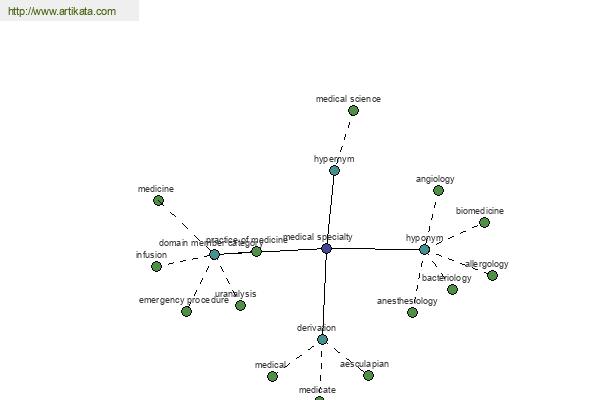 Explore medical specialty in ArtiKata.com >